
After 400 years of silence, a seemingly new — but ever-unfolding — story begins.
Enter Mary: an unknown woman with a meager introduction revealing little of who she is — a virgin, engaged to a descendant of King David — and curiously described as a “highly favored” woman whom the Lord is with.
Historians and scholars believe that likely, in first-century Nazareth, Mary was a young peasant girl, around 13 years old, whose daily life was filled with chores, domestic duties, prayer and preparation for marriage. She was betrothed (the first of a two-step marriage process) to Joseph. This betrothal was a dance of navigating the cultural norms of legal marriage while living with family and awaiting her marriage’s final stage — joining Joseph in his home.
Mary would have participated in Jewish traditions, praying and living a life centered on God. For a Jew, these faithful practices would have warranted her to be greeted by the angel as “highly favored,” or as our catholic brothers and sisters remind us, “full of grace.” And though much time had passed, God’s people (Mary included) would have still clung to God’s promises of a coming Messiah given to Adam (Gen. 3:15), Abraham (Gen. 12:3), Judah (Gen. 49:10), David (2 Sam. 7:12-16), Isaiah (Isa. 7:14) and Micah (Mic. 5:2).
In Nazareth, a small, quiet agricultural Galilean village, her life wasn’t grand or central to major events. Mary was likely unaware that God had chosen her for an extraordinary role in history.
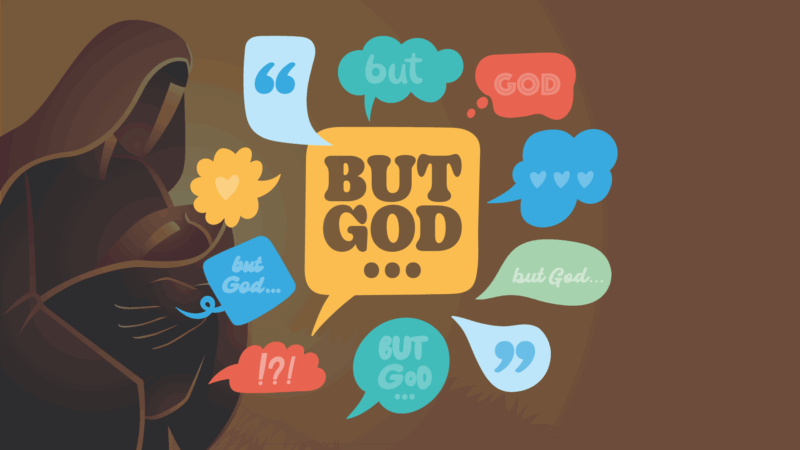
But God …
The angel Gabriel appears to her declaring:
Do not be afraid, Mary; you have found favor with God. You will conceive and give birth to a son, and you are to call him Jesus. He will be great and will be called the Son of the Most High. The Lord God will give him the throne of his father David, and he will reign over Jacob’s descendants forever; his kingdom will never end (Luke 1:30-33).
What a statement! I can only imagine it spurred on more confusion, fear and disturbed feelings.
“What do you mean I have found favor with God?”
“I am to conceive a child?”
“He will be great … the Son of the Most High … a king from David’s throne?”
“A never-ending kingdom?”
“How are any of these things possible?”
But God didn’t stop there! He had more to this incredible, unbelievable plan.
The Holy Spirit will come on you, and the power of the Most High will overshadow you. So the holy one to be born will be called the Son of God. Even Elizabeth your relative is going to have a child in her old age, and she who was said to be unable to conceive is in her sixth month. For no word from God will ever fail” the angel declares (Luke 1:35-37).
From this declaration that settles few questions and raises even more, Mary answers:
I am the Lord’s servant. May everything you have said about me come true (Luke 1:38, NLT).
How bold a response. How confident a declaration. How trusting a commitment, to step into the impossible promises of God! Perhaps their conversation was longer, but what we are given is enough to reveal her remarkable trust.
Gabriel’s visit to Mary serves not only as part of the Messiah’s birth story, but also as an encouragement to God’s people. Like Mary, we can faithfully trust the God of the impossible, who time and again reveals his immense love and grace for his creation — his people, his children. In a quiet village, to an unknown girl, in an ordinary moment, God enters and does what only he can do through and for Mary (and you): “But God …”
As we navigate our ever changing, confusing and sometimes hopeless world, we are reminded each year as we read the annunciation of Mary that amid every confusion, fear and disturbed feeling — “But God ...”
But God is the One who moves and does the impossible.
The One who created all things and made humankind in his image.
The One who consistently bridges the gap sin creates.
And the One, who out of his immense love for his creation, gave his one and only Son (John 3:16).
A Son who did not consider his divinity as something to cling to but instead made himself nothing, taking on the very nature of a servant, being made in human likeness (Phil. 2). Becoming the One born to Mary, fulfilling God’s greatest promise to defeat Satan, and redeem and restore all creation to God.
“For no word from God will ever fail” (Luke 1:37).
Like Mary, trust that no word from God will ever fail — this season and every season to come!
Rev. Jaena Gormong is the worship pastor for Oasis: College and Young Adult Ministry at GracePoint Wesleyan Church in Brookings, South Dakota.
All Scripture quotations, unless otherwise indicated, are taken from the Holy Bible, New International Version®, NIV® Copyright ©1973, 1978, 1984, 2011 by Biblica, Inc.® Used by permission. All rights reserved worldwide.
Holy Bible, New Living Translation, copyright © 1996, 2004, 2015 by Tyndale House Foundation. Used by permission of Tyndale House Publishers, Inc., Carol Stream, Illinois 60188. All rights reserved.
