
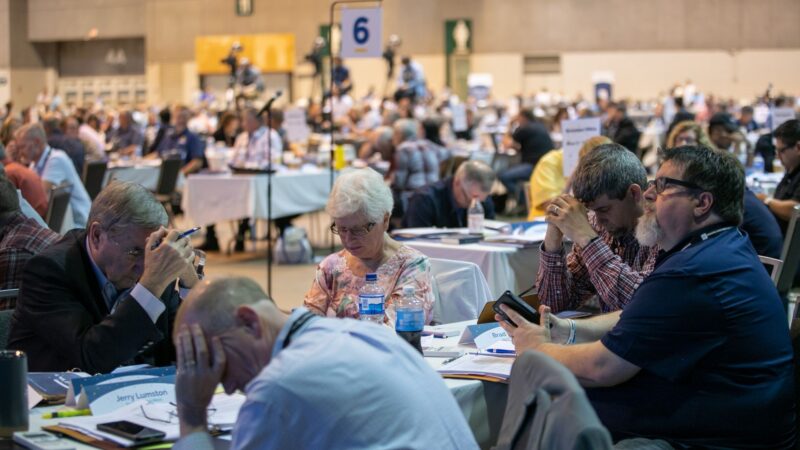
In The Wesleyan Church, delegates serve as a living link between the everyday life of local congregations and the decisions that shape the wider denomination. “The Discipline” describes the General Conference (GC) as the church’s supreme governing body. It seats an equal number of ordained ministers and lay members so that clergy and laity steward the church’s life together through representative decision-making.
“Business is worship when delegates prayerfully seek God’s wisdom, reflect Christ in their words and make Holy-Spirit led decisions,” said General Secretary Janelle Vernon. “Delegates to the 15th General Conference determine our future as they act on the nearly 60 memorials impacting our ongoing mission.”
It is during the business sessions when memorials are being discussed that the value of balanced representation is evident. Having balanced representation through deliberations and voting strengthens.
That representative pathway begins close to home. Lay delegates to district conference are chosen by the local church conference through a ballot and majority vote, then certified to the district. District leadership sets the allotment, so each pastoral charge receives representation, and the district conference maintains parity between ministerial and lay voting members. In practice, delegates bring their congregation’s story, priorities and perspective into the room where a district handles governance and shared mission across churches.
“For me, being elected a delegate from my district is a privilege and a huge responsibility,” said Linda Hill Sherman, a lay delegate from the Kentucky-Tennessee District. “I pray for wisdom.”
Delegates also carry a real responsibility of presence. When someone accepts election as a delegate, “The Discipline” frames that acceptance as a commitment to faithful participation through the full session, with room for unforeseen circumstances that might require study. District conference proceeds the same way, since a quorum for business includes both ministerial voting members and lay delegates, which means delegates are load-bearing participants in everything the conference does.
“I was only four years old when General Conference was at Lake Junaluska, so I don’t remember going to that one,” said Starr Cromer, a lay delegate from the North Carolina East District. “The first one I have a clear memory of was in Indianapolis in 1980. I believe that we have had a family member serve as a delegate at every GC since 1920 (that was my granddaddy who was a member of High Pine in Asheboro).”
At General Conference, delegates serve as custodians of the church’s future, and first responders to the church’s present opportunities, challenges and calling. They deliberate and vote as one body, and when a divided vote is called, ministerial and lay delegates each vote as their own branch, with action requiring a majority in both branches. Delegates arrive through district conference election, tied to membership statistics that shape how many delegates a district elects, and they serve as representatives who meet clear leadership and membership qualifications. Through that work, delegates help carry the voice of districts into the decisions that order the church’s doctrine, governance and common life.
For more information on General Conference, visit Wesleyan.org/15thgc.
Rev. Ethan Linder is the pastor of discipleship at College Wesleyan Church in Marion, Indiana, and contributing editor at The Wesleyan Church’s Education and Clergy Development Division.
