
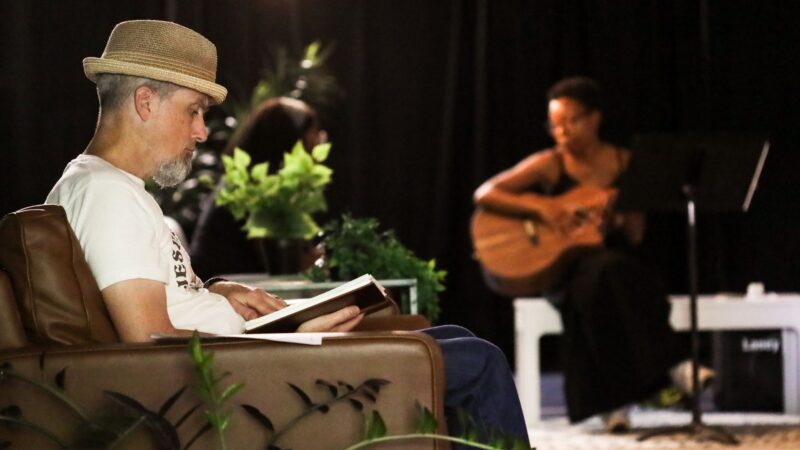
Vania Claiborne has long lived at the intersection of creativity and congregational life. She grew up in the arts, became a Christian at 16 and soon began to see those parts of her life began to overlap. “My ministry has always been to artists,” she said.
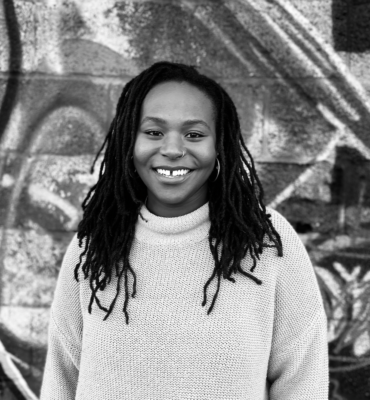 For years, her life kept circling the same questions: How does creativity belong to God? How do artists belong in the church? How can beauty become part of the way people are formed into the likeness of Christ? At times, she felt as if she had to choose between “arts or Jesus,” even while her own life was showing her that those callings belonged together.
That integration began to take shape through Emmaus Church in Greensboro, North Carolina, where Vania was invited to serve as director of Art and Prayer. “Kind of a funky title,” she shared. The title reflected an experiment Emmaus was imagining with her: a church choosing to place creativity at the center of prayer, worship and discipleship, convinced that creativity is part of stewarding the image of God.
The pandemic sharpened that experiment. Vania saw people carrying spiritual, emotional and relational wounds, and she sensed churches had often leaned on information as the primary tool for formation. “Mental assent to certain doctrine ideologies does not equal heart change,” she said.
Vania affirms preaching, teaching and Scripture, and she also believes the church is called to form whole human beings. People are shaped not only through ideas but also through story, memory, sound, image, touch, taste, beauty and embodied response.
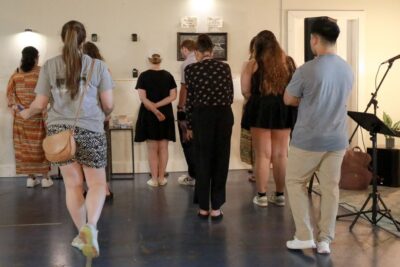 That conviction has motivated creative experiments at Emmaus, including a Stations of the Cross experience built as an immersive art gallery. Participants saw, touched, tasted, reflected and responded. Vania describes those spaces as “experiential devotions,” environments designed to help people encounter God’s story with their whole selves. People lingered in the stations and came away, moved by how art helped them inhabit what they had heard and believed. That response led Vania to wonder whether this work might serve more than one congregation in Greensboro.
That question eventually became Make Good Art, a mission under the North Carolina East District of The Wesleyan Church. Its work centers on discipling and empowering artists while helping churches become patrons and partners in the creative work of formation.
“The NC East District is proud to partner with Vania and Emmaus Church,” shared Dr. Tim Jones, North Carolina East’s district superintendent. “We are grateful for her commitment to another expression on presenting the gospel of Jesus in our hurting world.”
For Vania, Make Good Art’s mission begins with helping artists understand their gifts as more than personal expression or professional craft. “Their gifting is actually a way in which God wants to reveal himself,” she said, “and the church needs that in its discipleship life.”
The church also has something to recover. Historically, churches often served as patrons of the arts, while many Christian artists today translate theological impulses into language that will be legible in secular funding spaces. Vania knows that tension firsthand. As a choreographer, she once created a duet inspired by her brother and rooted in her desire for people to see Black men as whole people bearing the image of God. “I just wanted to do this because I love my brother, because I love Jesus, because we are made in the image of God,” she said. “I wanted to be able to talk about it that way, too; but not every space would resonate with that.”
Make Good Art asks what might happen if churches helped fund and resource artists whose work is shaped by Christian imagination, biblical themes and spiritual formation. What if artists were welcomed into the life of a congregation to help the church see, pray, remember and respond?
One artist helped Vania see how this might work. He was a worship leader and recording artist, and a church allowed him to use a room as a studio. There he created a visual album exploring his journey as a believer. When churches hosted an event showcasing his work, people encountered a story of faith, struggle and perseverance through music and visual art. His testimony was something they could experience.
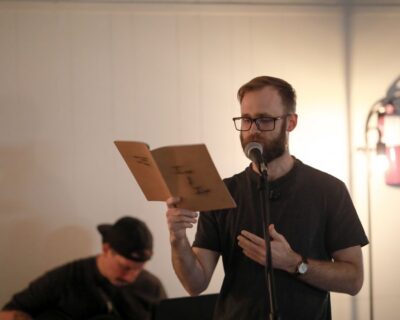 For Vania, that project brought the vision into focus: an artist had a biblical reality to share, the church provided space and support, and the creative work invited people toward transformation.
Vania is still in the early stages of building the model. The local expression will depend on the artist, the church and the season, but the deeper question remains the same: how can the artist’s craft help the congregation enter more fully into the story of God?
“How do we become a catalyst for this functional belief that people need beauty for their formation?” she said.
There are budgets to build, agreements to write, boards to form and models to test. Some things will work, and some things will fail. Vania is learning to receive both as part of the process. “The Lord decides how this goes,” she said. “It’s not mine. It’s this thing that I get to be a part of, and he’s doing his thing, and I’m just showing up.”
That posture may be one of the clearest gifts Make Good Art offers the church: an invitation to experiment with beauty as a practice of discipleship. It invites artists to offer their gifts with support, and it invites the church to remember that formation often happens when people are helped to go beyond thinking about faith and embody it.
Rev. Ethan Linder is the pastor of discipleship at College Wesleyan Church in Marion, Indiana.
