
Like many Wesleyan Holiness people, this time of year in the church was relatively quiet in our tradition. Lent, Ash Wednesday, Maundy Thursday, Good Friday, Holy Saturday were known by name only with a few tidbits of information but were primarily considered observations and practices by other faith traditions.
In a number of Wesleyan Holiness churches, there was encouragement to observe all-church prayer and fasting during the springtime, but primarily our eyes were focused on Easter Sunday. Plays and Easter cantatas (musicals) were given our main attention.
What we mostly knew about the Lenten season could be summed up rather quickly: 40 days of fasting leading up to Easter, ashen crosses placed on foreheads on a day called Ash Wednesday and people eating fish on Fridays — which most of us didn’t understand. These tidbits of information were incomplete … they were just “tidbits,” partial scraps of a practiced devotion to the passion of Christ by others.
The unfortunate reality is that far too often we go about our lives as if Christ’s passion — his death and resurrection — never happened. The reasons for such indifference may be wide and varied. It is far too common for life’s responsibilities and cares to crowd it out of our minds, to erode our regular rhythms of communion with our Lord through daily prayer and Bible reading.
Lent seeks to interrupt our lives by reminding us of what is forgotten, calling us back to life’s spiritual realities. It shouts at us to awaken to any sin or indifference toward God and others that exists within us and put it to death. Lent is also an invitation for us to enter once again into the joy of the Lord made possible by death to self and life in Christ Jesus.
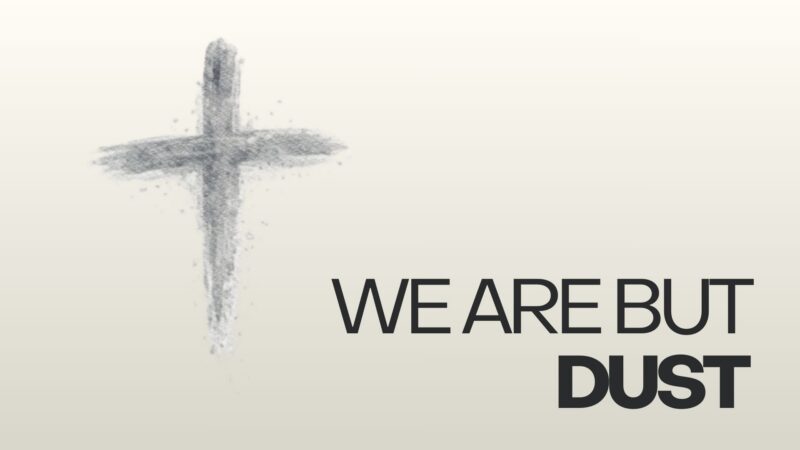
Ash Wednesday is the beginning of this Lenten season of interruption. On this day we remember the words from Genesis, chapters 2 and 3, that we are but dust — lifeless and without form until …
… the Lord God formed us [a man] from the dust of the ground and breathed into his nostrils
the breath of life, and we [the man] became a living being.
And we, living breathing human beings will “return to the ground” from where we were taken …
for dust we [you] are
and to dust we [you] will return.
On Ash Wednesday, some churches remember our dusty human frailty by applying ashes in the shape of a cross to the forehead of those who come as a start to their Lenten observation. These ashes are a symbol of our mortality. When applied on Ash Wednesday, we are reminding ourselves, as they proclaim outwardly to others, that all of us were created from dust, enlivened by the breath of God, saved through the power of Christ’s blood shed on the cross, and live in the hope that Christ does something beautiful with ashes.
Our lives are a gift. We did not just happen to appear or exist out of nothing. We were created and given life as a gift of love from God.
In and through this practice of applying ashes, the Ash Wednesday services and the Lenten season, we are being reminded that “God is God, and we are not.” We are but dust — frail humans in great need of a Savior. And as we walk through this season, we are enabled to recognize that death doesn’t have the final word … GOD, the giver of life, does.
As we face our own mortality, we have HOPE, real hope … because of God’s love, because of Christ’s passion, because of his resurrection — we who have placed our faith in and walk obediently with our Lord have been promised that we will also be resurrected to be with him eternally.
A good place to begin our journey through the Lenten season on Ash Wednesday is to start with an honest, humble look at ourselves and the world around us. Where are the frailties and brokenness in us, personally and communally?
Jesus said in John 12:24 (NLT), “I tell you the truth, unless a kernel of wheat is planted in the soil and dies, it remains alone. But its death will produce many new kernels—a plentiful harvest of new lives.”
How might Christ be calling us to die to ourselves this Lent? Will you choose to die so others might live?
Join your Wesleyan brothers and sisters in this deeply, profound act of worship in observing Lent. Let’s worship the one who created and is saving us by asking the Holy Spirit to examine our lives, show us where we need to surrender ourselves to God and ask him to make us holy.
May through our Lenten worship we once again take up our cross and be the good news of the gospel to those around us.
Rev. Angela Alvarado is the assistant editor for the Communication and Administration Division of The Wesleyan Church, an ordained elder and graduate of Wesley Seminary, Marion, Indiana.
Holy Bible, New Living Translation, copyright © 1996, 2004, 2015 by Tyndale House Foundation. Used by permission of Tyndale House Publishers, Inc., Carol Stream, Illinois 60188. All rights reserved.
